Writing into Painting
Writing and painting are two ways in which I explore the same questions. In this section, my published texts become starting points for visual reflection. Rather than illustrating what I have written, I return to the ideas, tensions, and questions behind the text and translate them into the language of painting.
The written argument may disappear, but its central question remains. Through symbols, colour, structure, and the visual language of Naive Symbolism, I allow that question to take another form. Each painting becomes an independent work — connected to the original text, but able to exist beyond it.
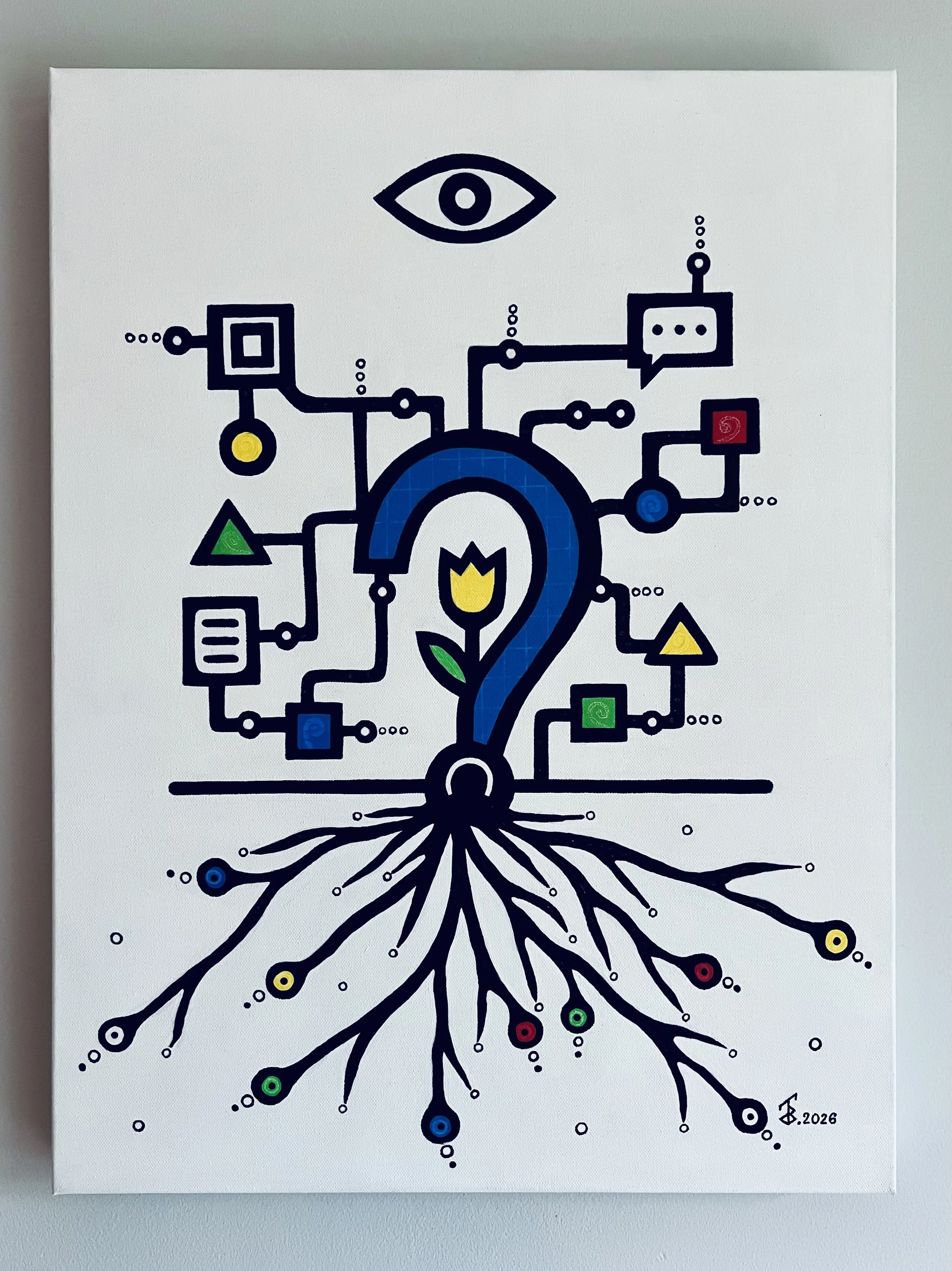
Title: The Question Before the Answer
Direction: Visual Thinking / Reflective Encounters
Medium: Acrylic on canvas
Dimensions: 45.7 × 61 × 3.5 cm | 18 × 24 × 1.4 in
Format: Vertical
Framing: Unframed, painted edges
Year: 2026
Related Writing: Is creativity under attack in the age of artificial intelligence?
Publication: The Clare Champion, The Fifth Column
Author: Tania Bond
Published: 4 September 2026
See the article →
About Artwork:
The Question Before the Answer was created as a visual reflection on Tania Bond’s column Is creativity under attack in the age of artificial intelligence?, published in The Clare Champion in September 2026.
The article considers creativity not as the ability to produce an answer, but as the capacity to recognise what deserves attention in the first place. As artificial intelligence makes answers faster and increasingly abundant, the work turns towards an earlier human act: noticing, questioning, and deciding what matters.
At the centre of the painting, a question mark becomes a structure connecting different signals, choices, and possibilities. Within it, a living form grows, while the surrounding geometric elements suggest information and competing directions. Above, the eye represents attention. Below, the root system extends into memory and accumulated experience — the less visible ground from which judgement and meaning emerge.
Through the visual language of Emotional Cartography, the painting maps the relationship between what we encounter and what we bring to it. The horizontal line separates the immediately visible field of information from the deeper structures that shape perception: memory, experience, and inherited ways of seeing.
The work does not ask whether human beings can compete with machines in producing more. It shifts the question elsewhere. In a world increasingly abundant in answers, creativity may depend on our capacity to recognise what is worth noticing — and which questions are worth asking.