Home / Gallery / Human Garden
The Anatomy of Becoming
How three paintings became the beginning of an artistic world. An artist’s story presented for the .ART Award 2026.
The Story
Reflecting on which painting to choose to tell the story of its creation, I realised that one painting would not be able to reveal the entire concept. After all, I do not simply create individual works — I create artistic worlds in which images, symbols and meanings are interconnected.
That is why I decided to tell the story of three paintings from my first world, Human Garden, with which everything began. United as Core Paintings, this triptych became its foundation, from which an entire system of artistic images, research and forms gradually grew.
But why did this world emerge in precisely this way? Why did Naive Symbolism become its language, Emotional Cartography its method, and the tulip its main character?
The answer begins long before the first three paintings.
More than twenty years of working in graphic and brand design shaped my attention to the visual sign — its ability to convey meaning through stylised form, colour, composition and identity. At the same time, I was fascinated by the study of symbols found in folk crafts, ancient cultures and the art of different peoples of the world: from Ukrainian pysanky and Trypillian ceramics to the ornaments and archetypal images of Celtic, Sumerian and Mayan cultures, African peoples, and so on.
Naive art held a special place in these explorations — its freedom from the literal depiction of reality, its rejection of traditional perspective and its ability to speak about complex things in a simple, direct language.
Gradually, I combined naive style and symbolism into my own artistic language — Naive Symbolism, where stylised form, clear outlines, flat colour and archetypal symbols become carriers of multiple layers of meaning.
But I was interested not only in individual symbols. I increasingly thought about the invisible connections between human feelings, emotions, memories, events and relationships. Could they be represented as a map? Could we give form to what we experience but cannot see?
This is how my method, Emotional Cartography, began to take shape — the translation of emotional and psychological experience into a system of symbolic images and visual interconnections.
Research became the foundation of the method, from which artistic worlds gradually began to emerge. I began with observation, the study of natural forms, psychology, cultural images and symbols. Then I searched for their internal connections, experimented with stylisation, created my own visual language and built a system in which each image found its place.
I showed this process not only in the finished works, but also in drawings, sketches, symbolic studies and compositional decisions. As a result, the artistic world acquired its structure long before all its parts appeared on canvas, in ceramics, sculpture or a book. For me, creating a finished work is not the beginning of research, but a way of making it visible.
And when I turned to the subject of the human being, I needed an image capable of telling the story of human becoming.
Why the tulip?
Its life begins with a bulb hidden beneath the ground. Roots develop from it, followed by leaves and a stem, and only later does a bud appear. In this gradual development of form, I saw a metaphor for human life: roots — origin and heredity; growth — the accumulation of experience and growing up; and the bud — the formation of individuality and a mature personality. Thus, the tulip became a metaphor for the human being, and the garden became a space where human stories, relationships and states meet.
Three paintings formed the foundation of Human Garden World:
Memory Garden (Family)
Shared Bloom (Friendship)
Inner Garden (Presence)
Each of them reveals a separate dimension of human existence. Together, they form a complete artistic statement.
How can we show what connects us to the past?
In Memory Garden (Family), the family becomes a vertical line of time — from ancestors through the present to future generations. White silhouettes of ancestral souls appear in the background. Bulbs and roots symbolise origins, while the buds repeat the features of parents and children: the resemblance between mother and daughter, father and son. How we inherit similarities in character, habits, preferences and patterns of behaviour. In this way, the past continues to live in new generations.
And what connects people who do not belong to the same family?
In Shared Bloom (Friendship), relationships develop horizontally. Here, three flowers are united not by kinship, but by shared interests, tastes, needs and emotional closeness. That is why they have no bulbs or roots, but the symbols in their buds resemble musical notes — the resonance of the strings of the soul, through which people find one another.
And finally, who are we ourselves among all these connections?
In Inner Garden (Presence), a centre appears — a person in the present, embodied in a large, fully formed bud. Behind it, the silhouettes of childhood and youth emerge in black outlines. Everything we have lived through remains behind us, but does not disappear: experience becomes part of who we are today.
Thus, the three paintings formed a kind of cross of human existence: the vertical line of inheritance, the horizontal line of relationships and the centre of individual presence.
I thought the story was complete. But the more deeply I looked into these images, the more questions arose.
How is memory transmitted?
What makes up individuality?
How does a person live through their experiences, make decisions and change under the influence of feelings and relationships?
What happens to them in moments of choice, loss, growth and transformation?
And what remains of the paths in life they never took?
Gradually, I realised: the three paintings were not the conclusion, but the foundation. Core Paintings became the basis from which, like from a bulb, new artistic directions began to grow.
Human Garden was only beginning to bloom.
The questions that emerged from the first three paintings gradually expanded Human Garden beyond the original series. This is how new directions in painting appeared:
Extension Paintings — an exploration of the life journey and the transmission of experience;
Structure Paintings — an exploration of the inner architecture of the human being;
Archetype Paintings — an exploration of archetypal states and transformations;
Reflection Paintings — an exploration of the multiplicity of personality, its relationships with the world and unrealised possibilities.
At the same time, this world was developing its own symbolic system:
12 Inner Symbols;
Atlas of Inner Symbols;
Grammar of Symbols.
And the research process, from natural materials and the first sketches to colour palettes, clay samples and sculptural drawings, found its material expression in Cartography of Becoming — a research moodboard preserving the artefacts of the creation of Human Garden World.
Gradually, Human Garden expanded beyond painting, taking shape through other artistic forms:
Sculptures;
Ceramic objects;
Children’s book;
Postcard;
Installations.
Each of these forms offers a different way to explore and experience the symbolic world of Human Garden.
Thus, what began with three paintings evolved into my first artistic world — an exploration of human identity, memory, feelings, relationships and continuous becoming.
But this is only the beginning.
I began with the human being, and I will continue my research towards territory — from the inner emotional cartography of personality to the emotional cartography of place.
And now, returning to the three paintings with which this story began, I understand: I wanted to tell the story of the creation of three works, but in the end, I told the story of the birth of an entire artistic world.
With reflections,
Tania Bond
The Three Core Paintings
-
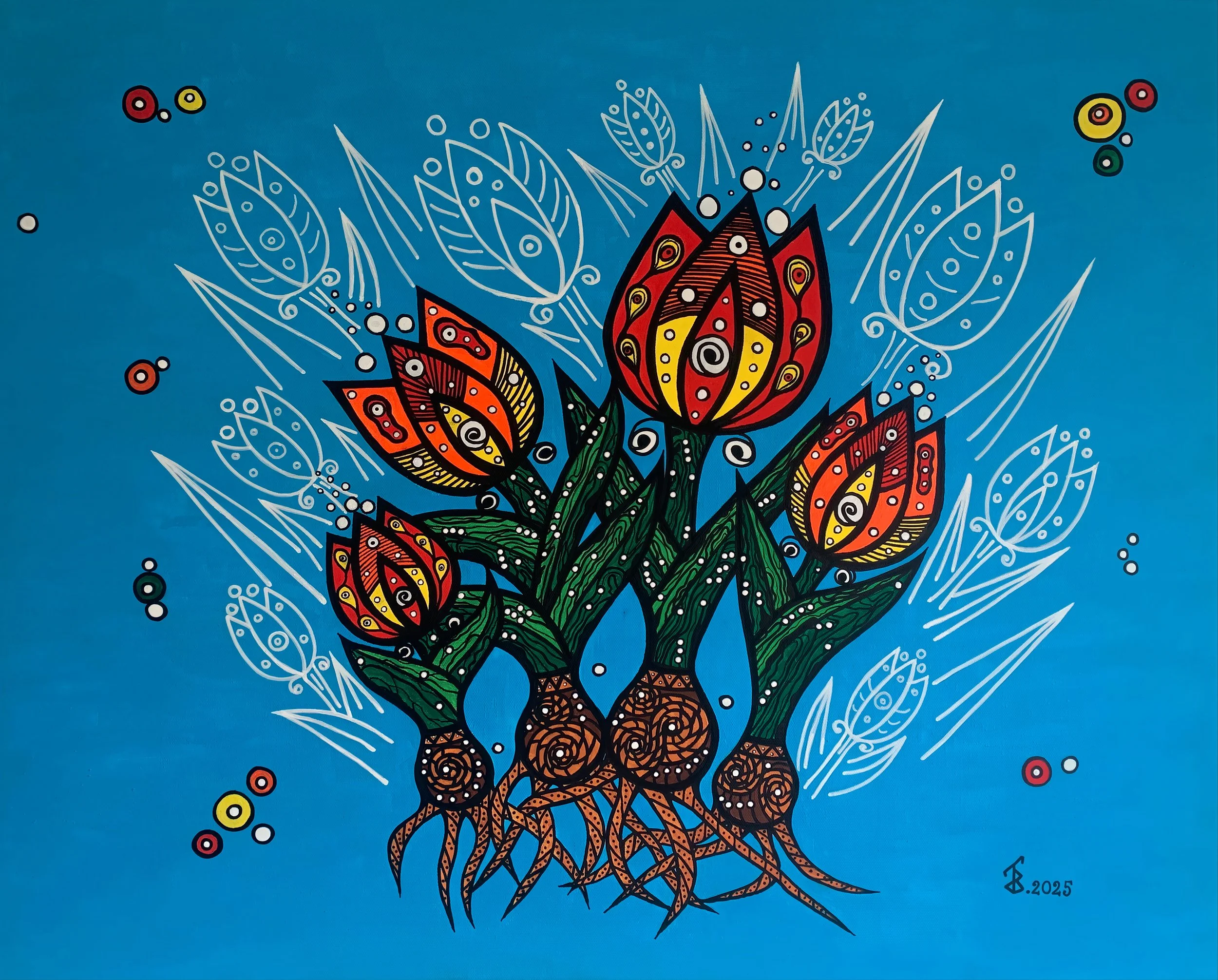
Memory Garden (Family)
2025 · Acrylic on canvas
61 × 76.2 × 3.5 cm
24 × 30 × 1.4 in -
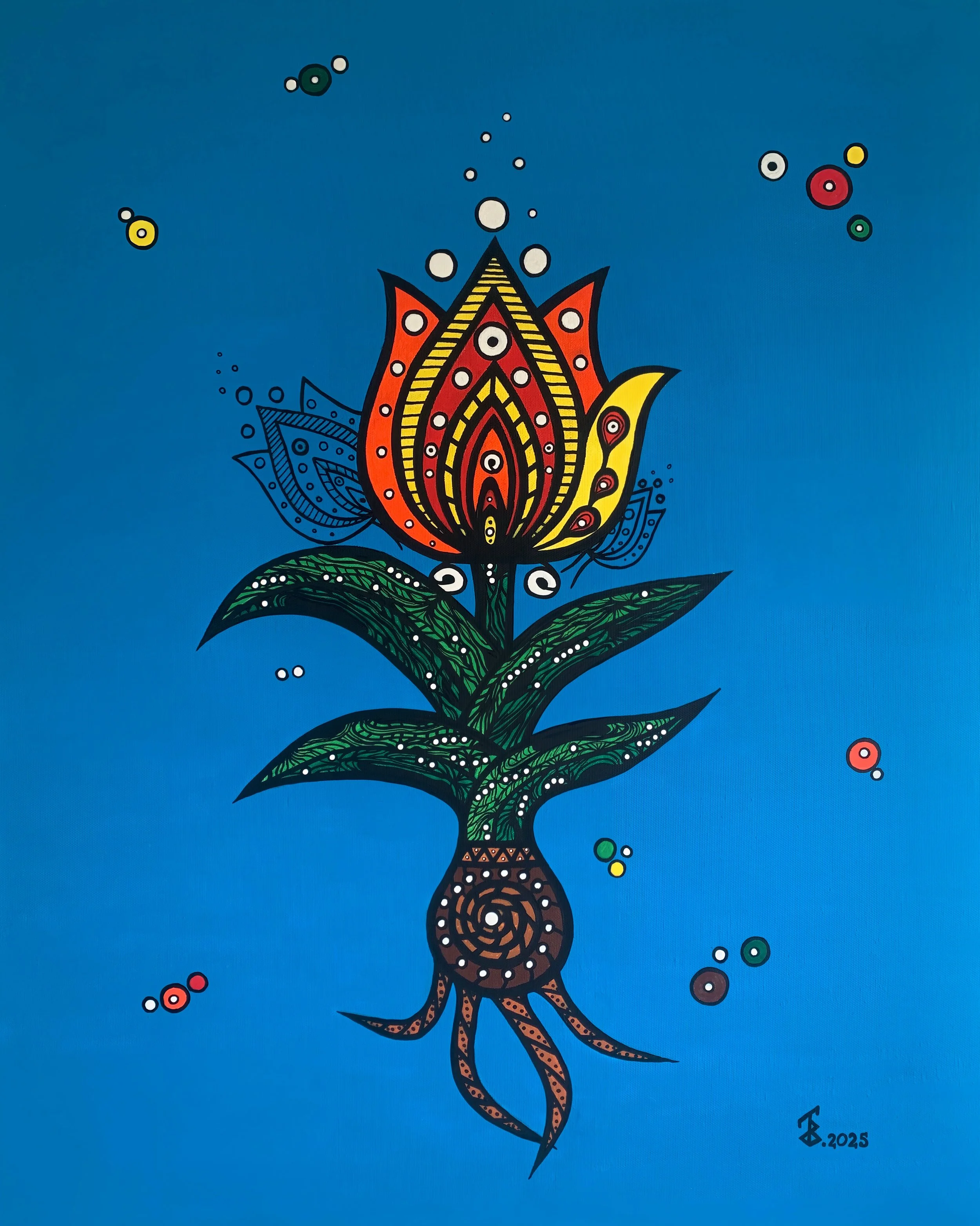
Inner Garden (Presence)
2025 · Acrylic on canvas
76.2 × 61 × 3.5 cm
30 × 24 × 1.4 in -
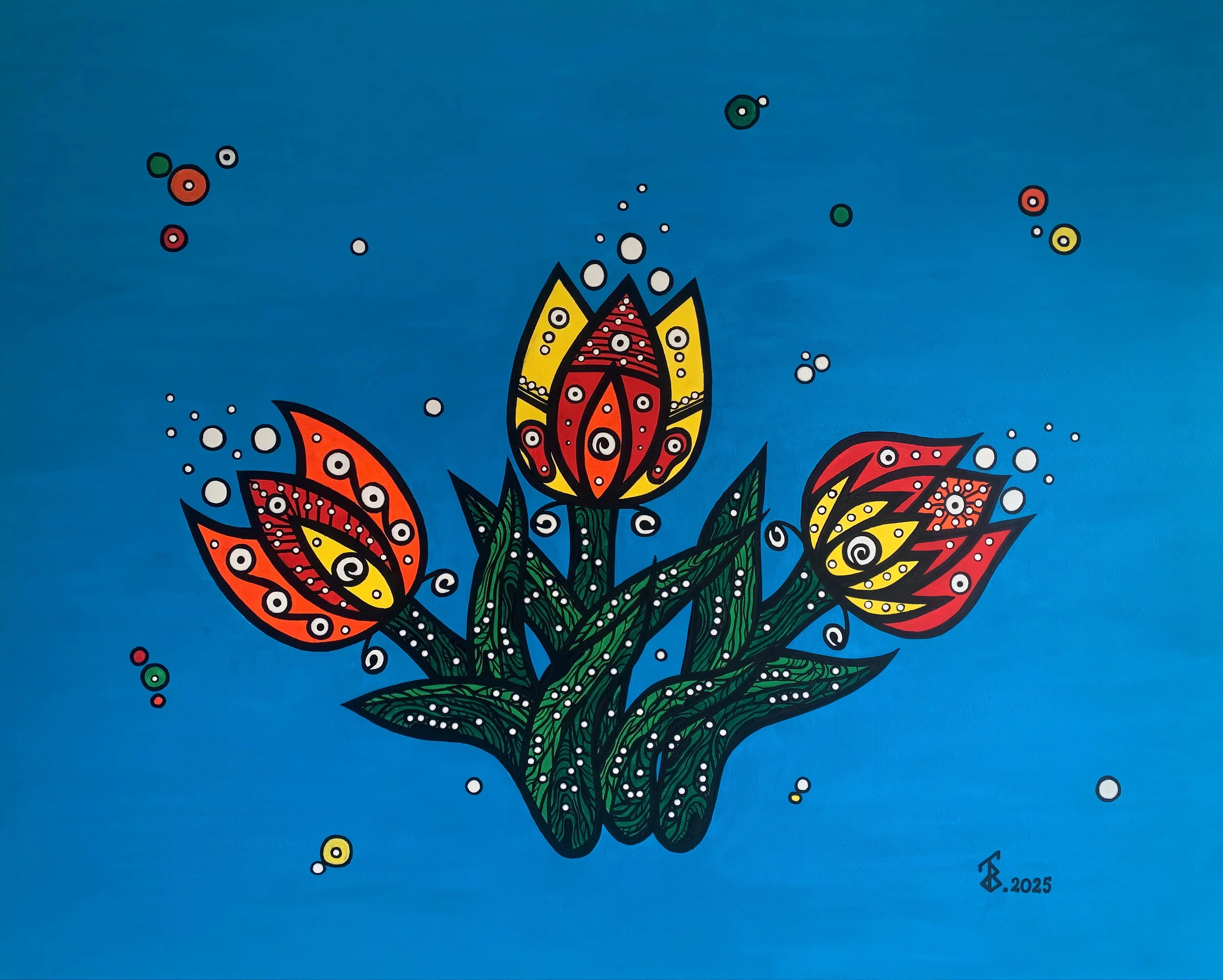
Shared Bloom (Friendship)
2025 · Acrylic on canvas
61 × 76.2 × 3.5 cm
24 × 30 × 1.4 in
About the Artist
Tania Bond is a Ukrainian-born visual artist based in Ireland. She works in the style of Naive Symbolism. Her practice explores human identity, cultural memory, and the relationship between nature, symbols, and emotional experience.
Her artistic language was shaped by the observation of natural forms, studies in archaeology and cultural symbolism, academic training in drawing and composition, and more than twenty years of professional experience in brand and graphic design.
After relocating to Ireland, she continued developing her artistic practice, bringing these influences together into a coherent visual system.
Through her original artistic method, Emotional Cartography, she creates interconnected artistic worlds in which symbolic forms reveal relationships between memory, identity, experience, and place.
Her first world, Human Garden, explores human becoming through botanical metaphors, painting, symbolic research, and interdisciplinary artistic forms.
Read Full Biography.